

How the US Government Allows for a Poor Food Supply
You always hear “big food” this and “big food” that, but never what actually allows them to commit their heinous crimes. This article doesn’t defend corporations, rather it hones in on the US regulations that allow them to get away with their wrongdoings. Instead of speculating or providing generalizations like those viral social media posts often do, you will find the actual federal regulation citations for each topic I discuss in this article. Most of these regulations make sense at face value: they assist with supporting a massive civilization but they almost always come at a detriment of consumer protections. The government often puts the people last, so this article is a big one.
INGREDIENT LABELING GIMMICKS
I. Natural and Artificial Flavors - US 21 CFR § 101.22(a)(3)
Natural flavors are ingredients that contain constituents derived from food items that serve a flavoring purpose rather than a nutritional one. Artificial flavors can be the same as natural flavors (or different), except they are not derived from food but instead originate from non-food substrates. The EWG provides a great read on the topic of flavors.
These are vague definitions, allowing manufacturers creative freedom to sell you the unhealthiest of ingredients that have been chemically adulterated into unrecognizable “flavors” hidden behind a labeling technique. For example, castoreum is a secretion from the castor sacs located next to the anus within beavers that is used in berry and vanilla natural flavors. Despite its "generally recognized as safe" status from the FDA, you can see how absurd these flavors can be. It should be noted that some flavors may not contain chemical abominations and are simply hiding trade secrets behind the “natural flavor” mask, however it is impossible to know. Some examples of isolated compounds commonly used as flavors are limonene, a citrus peel compound; linalool, a plant compound; and vanillin, an extract from vanilla.
II. Incidental Additives - US 21 CFR § 101.100(a)(3)
Incidental additives are substances “that are present in a food at insignificant levels and do not have any technical or functional effect in that food.” This is so vague that we consumers have to do mental gymnastics trying to understand what they could truly be. No definition of “substances” is provided, but it seems to be different from “ingredients” which at least come from food. There is no prescription in the regulation for what an “insignificant level” actually is. A manufacturer/seller could argue that a harmful substance has no “technical or functional effect” in that food. This regulation seems to be nothing more than a way to protect companies from consumer fears by allowing them to leave off any potential dangers from their labels.
III. Processing Aids - US 21 CFR § 101.100(a)(3)(ii)
Processing aids, a specific class of incidental additives, are substances that meet one of three definitions:
- Are added during processing but are removed “in some manner” before it is finally packaged
- Are added during processing, become something that is normally in that food and does not significantly raise the quantity of the “something” that is in the food
- Are added during processing for their technical or functional effect but remain in “insignificant amounts” and no longer have a technical or functional effect in the food
It’s all so tiresome. One example of a specific processing aid is ethyl butyrate added to orange juice for flavor. If you have noticed that different bottles of OJ from the same brand all taste the same it is because the orange juice is stripped of its oxygen during manufacturing, which prevents spoiling but also gets rid of all flavor. When it’s time to sell, manufacturers add ethyl butyrate and other esters (aromas, essences, artificial flavors) back to the orange juice to give a uniform flavor. The compounds that are added back to OJ are exempt from inclusion on ingredient lists because they are chemically the same as what was naturally occurring and lost during de-oxygenation.
Another example is ethylene gas sprayed on unripe bananas to artificially ripen them. Since ethylene gas is normally created by fruits and vegetables as they age, manufactures don’t need to disclose their artificial usage of the gas.
Thanks to all of these crutches given to big food, our food hardly undergoes authentic natural growing processes and we end up with countless harmful ingredients.
CALORIE COUNT LIES & MACRONUTRIENT ERRORS
I. Calorie Count Increments - US 21 CFR § 101.60(b) & US 21 CFR § 101.9

How can a cooking oil spray be zero calories when using cooking oil normally has loads of calories? Our laws allow serving sizes containing less than 5 calories to be labeled as 0. Yes. Any food containing less than 5 calories per serving is legally allowed to declare 0 calories and say “zero calorie”, “no calorie” or “calorie free”. If a food has more than 5 calories, the label can round to the nearest multiple of 5. If greater than 50 calories, round to the nearest multiple of 10.
These serving sizes were set through eating pattern statistics gathered from 40-year-old health surveys, which means manufacturers probably lobbied for their “reference amount” serving sizes to be low enough for those serving sizes of cooking oil to be small enough to contain 4.9 calories and thus able to declare a whopping 0 calories. Even GROUND's real fruit flavor ingredients contain a small amount of calories, despite reading zero because all real food ingredients will have some amount of protein, carb or fat in it.
II. Nutrient Error Allowance - 21 CFR § 101.9(g)
When you pick up two packs of the same bacon at the grocer, they will display the same calorie count and the same quantity of each nutrient (macro and micro). However, the actual strips of bacon inside the pack may be wildly different: a lot more meat in some and a lot more fat in others. This natural variation can create inaccuracies in the nutrient quantities and calorie counts (1g of fat = 9 cal | 1g of protein = 4 cal) between packs of food.
While this is understandable, consumers should still get what we pay for, but according to the US government it is perfectly fine if we only get 80% of what we pay for. The code section states that for naturally occurring nutrients “the nutrient content of the composite must be at least equal to 80 percent of the value for that nutrient declared on the label.” There is also a cutout for certain nutrients that are permitted to be up to 20% greater than the listed quantity and this includes calories too. To fully grasp the margin of error that they afford these companies and how it impacts your purchases, I highly recommend you read the entirety of paragraph (g) of this law.
STRAIGHT BULLSH*T
I. Bioengineered Food Disclosure - US 7 CFR § 66.3
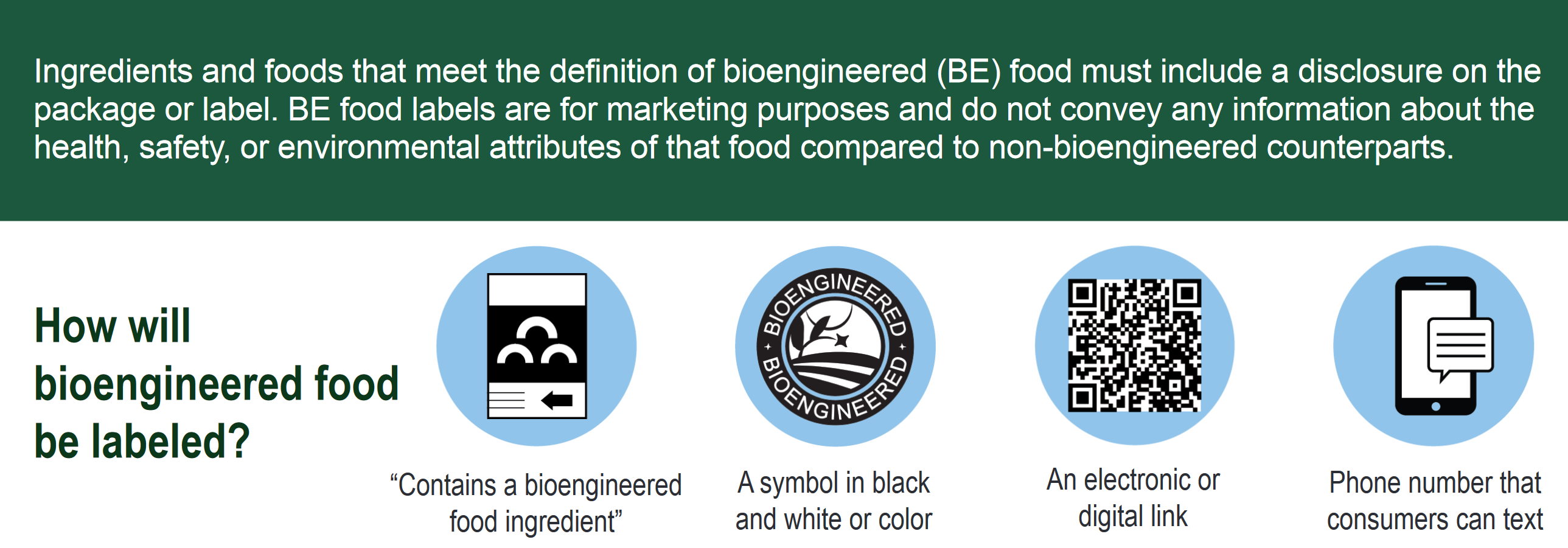
Is your food bioengineered? Companies are legally allowed to barely tell you that fact! They can tuck something that many consumers want to know into some small, inconspicuous corner of the label or hide it behind layers of steps such as QR codes or phone numbers to contact.
II. California Prop. 65 Warning - OEHHA
California has a “right to know” law, Prop. 65, that requires companies to notify consumers if a product exposes them to certain harmful chemicals. The law is (rightfully) very strict so the exposure thresholds for the chemicals are so low that it opens up companies without proper warnings to lawsuits for any “significant” amounts of these chemicals in their products. However, rigorous testing for these chemicals is very expensive, so companies simply opt to slap the warning label on all of their products and call it a day.
When companies freely slap the Prop. 65 warning on their products, liability surrounding Prop. 65 is removed and they tend not to undergo as much safety testing. Consumers are left with less safety testing and useless warnings.
III. Example of Inconspicuous Labeling

They think we are stupid. This speaks for itself.
THE GROUND RULES
Learn the tactics that big food uses to deceive its customers. Once you know what to look for, shopping for food is far less overwhelming. Not knowing what an ingredient is doesn't automatically render it harmful, but if you simply avoid ingredients that are hard to pronounce, you can avoid the vast majority of unnatural and harmful ingredients.
Slowly make adjustments to what you stock your pantry with, rather than throwing out everything and trying to start from scratch. You don't need to stress about any of it, rather feel peace when you are intentionally improving your knowledge, your health and your wallet.